 Pujaabhishekam Blog
Arulmigu Sri Guru Bagavan Dakshinamoorthy Temple Guide
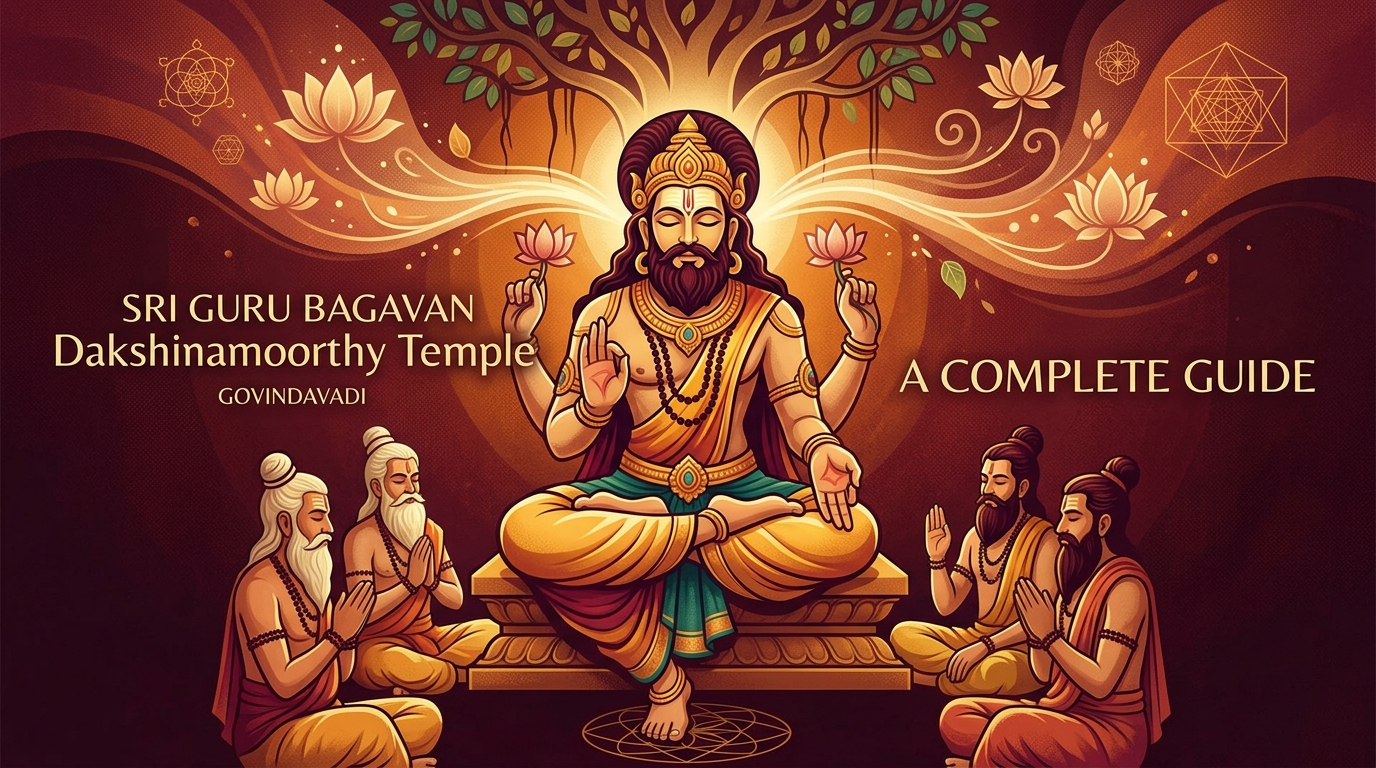
If you have ever searched for a Shiva temple where Lord Dakshinamurthy himself is the main deity and not just a small niche on the outer wall, you have probably landed on the same name over and over: Arulmigu Sri Guru Bagavan Dhakshinamoorthy Temple in Govindavadi. It is one of those quietly powerful places that does not shout for attention, yet devotees travel from across Tamil Nadu, especially on Thursdays, just to stand before this rare form of Shiva as the Guru of the universe.
This guide walks you through everything you need before you plan your visit: the legend behind the temple, its architecture, timings, festivals, how to reach it, and the small but useful details that most travel pages leave out.
Where Is the Temple Located
The temple sits in Govindavadi village, near Agaram, in Kanchipuram district, Tamil Nadu, about 18 km from Kanchipuram town on the Kanchipuram-Tiruthani road. It is a small, unassuming village, and that is part of the charm. You will not find heavy commercial crowds or rows of shops around it. What you will find is a quiet temple town feel that makes the darshan more personal.
Address: Govindavadi Dakshinamurthy Temple, Temple Street, Govindavadi, Kanchipuram District, Tamil Nadu - 631502
The Legend Behind Govindavadi
Every old Shiva temple in Tamil Nadu carries a story, and Govindavadi's is genuinely unique. According to temple legend, during a fierce war between the Devas and the Asuras, Lord Vishnu's Sudarshana Chakra accidentally fell upon Sage Dadheechi and lost its divine power. Troubled by this, Vishnu decided to seek Lord Shiva's grace to restore it.
Vishnu, along with his consorts, took a holy dip in the temple's sacred tirtha (water body) and performed penance. Pleased with his devotion, Shiva appeared before Vishnu not in his usual form, but as Guru, the supreme teacher, and initiated him into sacred mantras. Shiva then instructed Vishnu to worship a Shivalinga at nearby Thirumalpur with a thousand flowers. Once Vishnu completed this worship, his discus regained its full power.
Because Shiva revealed himself here in the form of a Guru, the presiding deity of this temple came to be worshipped as Dakshinamurthy, the teacher aspect of Shiva. Some local accounts also connect the very name Govindavadi to this event, since Govinda is another name for Vishnu, who was tutored at this spot.
What Makes This Temple So Rare
In almost every other Shiva temple across South India, Dakshinamurthy occupies a small shrine or a carved niche on the southern outer wall of the main sanctum. He is present, but he is rarely the star of the show.
Govindavadi flips that completely. Here, Lord Dakshinamurthy is the main and independent presiding deity, seated in a striking form over six feet tall on a peeta, facing south in his traditional teaching posture. Behind this main sanctum is a separate shrine for Lord Kailasanathar, with both sanctums sharing a single vimana (tower). Goddess Akhilandeswari is worshipped here as the consort, and you will also find an idol referred to locally as Chandana Kunkuma Govinda.
This is why many devotees and temple historians describe Govindavadi as one of the very few, and possibly the only, standalone temples in India built exclusively for Dakshinamurthy as the primary deity rather than a secondary one.
Is This the Same as the Navagraha Guru Temple in Alangudi
This is a genuinely confusing point online, and most blogs never clear it up, so let's settle it here.
There is another well known "Guru Bhagavan" temple, the Arulmigu Abathsahayeswarar Temple at Alangudi near Kumbakonam in Thiruvarur district. That temple is one of the nine official Navagraha Sthalas (planetary temples), specifically representing Guru or Jupiter, and Dakshinamurthy is worshipped there as a planetary deity alongside the main deity Abathsahayeswarar.
The Govindavadi temple near Kanchipuram is a completely different shrine, located in a different district, with a different legend, and it is not part of the official Navagraha circuit. What connects the two in people's minds is simply the shared association with Guru, since Dakshinamurthy governs the planet Jupiter in Vedic astrology in both places. If you searched for "Guru Bhagavan temple" hoping to find Kanchipuram's Govindavadi shrine specifically, this is the one, not the Navagraha temple near Kumbakonam.
Temple Timings
Regular days:
- Morning: 7:00 AM to 12:00 PM
- Evening: 4:00 PM to 8:00 PM
Thursdays (special day for Guru Bhagavan):
- Morning: 5:00 AM to 1:00 PM
- Afternoon and Evening: 1:00 PM to 9:00 PM
Timings can shift slightly during festivals or special poojas, so it is worth a quick call ahead if you are travelling from far.
Best time to visit: September to February, when the weather is cooler and more pleasant for temple visits in this part of Tamil Nadu.
Festivals and Special Pooja Days
Thursday, the Guru's Day
Thursday is considered the most spiritually significant day at this temple because it is astrologically linked to Guru or Jupiter. Special poojas are performed specifically for Guru Bhagavan, and the temple sees noticeably heavier footfall. If you want a quieter, more reflective darshan, weekdays other than Thursday tend to be far less crowded.
Guru Peyarchi Pooja
Whenever Jupiter transits from one zodiac sign to another, the temple conducts a special Guru Peyarchi pooja. This is one of the most sought-after events here, drawn by devotees hoping to ease the effects of Guru dosha or planetary afflictions related to Jupiter in their horoscope.
Guru Puja and Mahasivarathri
Guru Puja is celebrated in the Tamil month of Chithirai (April to May), and Mahasivarathri is observed with a Sangabishekam ritual during Masi (February to March). Both draw large numbers of devotees and are good occasions to witness the temple at its most vibrant.
How to Reach Govindavadi Temple
By Road - Govindavadi is about 18 km from Kanchipuram on the Tiruthani road. Regular buses running from Chennai to Kanchipuram via Arakonam pass through this route. Get down at the Agaram bus stop and take a short auto ride to reach the temple.
By Train - The nearest railway stations are Tiruthani and Arakonam. From either station, you can hire a local taxi or auto to complete the journey to Govindavadi.
By Air - Chennai International Airport is the nearest airport, roughly a couple of hours away by road depending on traffic, making this an easy day trip from Chennai.
Online Booking and Pooja Services
The temple is managed by the Hindu Religious and Charitable Endowments (HR&CE) Department, Government of Tamil Nadu. Special poojas, including Guru Preethi pooja meant to reduce the malefic effects of Jupiter, can be booked in advance through the official HR&CE portal at hrce.tn.gov.in. On the site, look for Temple Booking Services, select the relevant temple service, choose your preferred date and slot, fill in devotee details, and complete the payment online. Keep a printed copy of your ticket for the visit.
Dress Code and Temple Etiquette
Any decent, modest outfit is acceptable for darshan. As with most Tamil Nadu temples, it is respectful to avoid shorts, sleeveless tops, or overly casual western wear. Footwear is left outside the temple premises, and photography inside the sanctum is generally restricted, so it is best to check with the temple staff before taking any pictures.
Nearby Places to Visit
Since Govindavadi sits close to Kanchipuram, one of India's most temple-rich towns, it is easy to combine your visit with a few other iconic stops:
- Kailasanathar Temple, one of the oldest structural temples in Tamil Nadu
- Ekambareswarar Temple, dedicated to Shiva in his earth element form
- Kamakshi Amman Temple, one of the major Shakti Peethas
- Varadaraja Perumal Temple, a major Vishnu shrine in Kanchipuram
Planning your trip around these along with Govindavadi makes for a full and satisfying day of temple hopping.
Travel Tips for First-Time Visitors
- Visit on a day other than Thursday if you prefer a calm, unhurried darshan.
- Carry water and light snacks, since the village itself has very limited dining options.
- Reach a little before opening time during festival days to avoid long queues.
- Combine your trip with Kanchipuram's major temples to make the most of the 18 km distance.
- Keep small cash handy for local transport and temple offerings.
Frequently Asked Questions
What is Arulmigu Sri Guru Bagavan Dhakshinamoorthy Temple famous for?
It is widely regarded as one of the rare, possibly the only, temples in India where Lord Dakshinamurthy is worshipped as the main, independent presiding deity rather than a secondary shrine on the temple wall.
Which planet is associated with this temple?
The temple is closely associated with Guru, or the planet Jupiter, in Vedic astrology. Devotees visit seeking relief from Guru dosha and other Jupiter-related planetary afflictions.
Is this the same as the Navagraha temple for Guru near Kumbakonam?
No. That is a separate temple, the Arulmigu Abathsahayeswarar Temple in Alangudi, Thiruvarur district, which is part of the official Navagraha circuit. Govindavadi is a different, standalone Dakshinamurthy temple near Kanchipuram.
Which day is best to visit?
Thursday is the most spiritually significant day, though it is also the busiest. For a quieter visit, choose any other weekday.
How far is the temple from Kanchipuram?
It is about 18 km from Kanchipuram town, along the Tiruthani road.
Can poojas be booked online?
Yes, poojas and sevas can be booked through the official Tamil Nadu HR&CE portal.