 Pujaabhishekam Blog
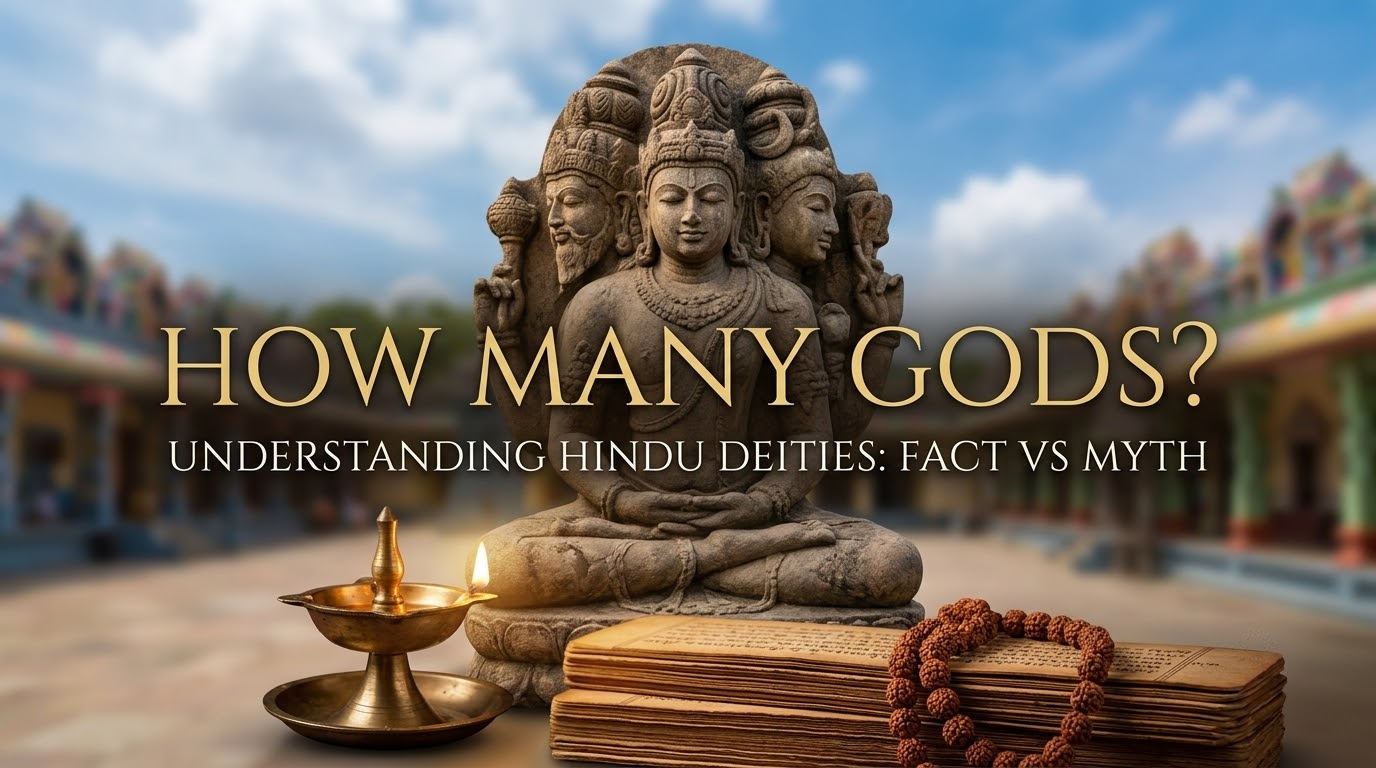
How Many Gods in Hinduism? Understanding Hindu Deities (Fact vs Myth)
You've probably heard it at some point, in a joke, a documentary, or even a school textbook: "Hindus worship 33 crore gods." That's 330 million deities. It sounds absurd, and honestly, it is. Because it's not true.
This single mistranslation has traveled so far and so wide that most people, including many Hindus, believe it without question. So let's actually dig into where this number came from, what Hindu scriptures really say, and how many gods Hinduism recognizes when you go back to the original Sanskrit texts instead of secondhand retellings.
The Short Answer: It Depends on How You Define "God"
If you're looking for a single number, here's the honest answer: Hinduism doesn't have a fixed headcount of gods the way a company has a fixed number of employees. What it has is:
- One ultimate reality called Brahman, which is formless and infinite
- 33 principal Vedic deities, not 33 crore, as named in the earliest scriptures
- Countless forms and names through which that one reality is worshipped, depending on region, tradition, and personal devotion
That last point is exactly why the "millions of gods" idea took root in the first place. But it's a misunderstanding of a Sanskrit word, not a scriptural fact. Let's break that down.
Where Did the "33 Crore Gods" Number Actually Come From?
The phrase everyone quotes traces back to a Sanskrit expression: trayastrimsati koti, found in the Yajurveda, the Atharvaveda, and the Satapatha Brahmana. Translated word for word, trayastrimsati means "thirty-three." The confusion is entirely about the second word.
The Koti Translation Error
The word koti has two very different meanings in Sanskrit:
- Koti as a number, meaning "crore" or ten million
- Koti as a description, meaning "type," "category," or "supreme"
Colonial-era translators and, later, popular retellings picked the numerical meaning and ran with it. Thirty-three koti became thirty-three crore, and the idea of 330 million Hindu gods was born and never really corrected in popular culture.
But 33 divinities are mentioned in the Yajur-veda, Atharva-veda, Satapatha-brahmana, and other Vedic and later texts, and the number thirty-three even shows up with reference to divinities in the Parsi scriptures of Avesta as well. That's a strong hint the number was always meant to be exactly what it says: thirty-three, not thirty-three million.
Even in everyday Hindi and Sanskrit usage today, you'll hear phrases like "uchh koti ka vidwan" meaning "a scholar of the highest order." Nobody hearing that sentence thinks it means "ten million scholars." The same logic applies to the gods.
The Real 33: Who Are the Principal Vedic Deities?
So who are these actual 33 gods that the Vedas talk about? According to the Brihadaranyaka Upanishad (chapter 3, section 9), the thirty-three Vedic deities break down like this:
The 8 Vasus (Deities of Material Elements)
These represent the fundamental forces and elements of nature:
- Dyaus – Sky
- Prithvi – Earth
- Vayu – Wind
- Agni – Fire
- Nakshatra – Stars
- Antariksha (Dyava) – Atmosphere
- Surya – Sun
- Chandra – Moon
The 12 Adityas (Solar Deities of Time and Cosmic Order)
These twelve gods are tied to the months of the year and the movement of the sun, representing different aspects of time, order, and cosmic law. They include deities like Indra, Vishnu, Mitra, Varuna, Bhaga, and others, depending on which text you read.
The 11 Rudras (Forms of Shiva)
The Rudras represent the fierce, transformative, and life-force aspects of divinity, closely associated with the god Shiva in his various manifestations.
The 2 Ashvins (Divine Physicians)
Twin gods associated with health, healing, medicine, and the break of dawn.
That's 8 plus 12 plus 11 plus 2, which gives you 33. Some texts add Prajapati or Indra as a 34th figure representing the totality, or count Indra and Prajapati within the existing 33, depending on the version of the list.
This is the actual, textually verifiable number behind the famous phrase. Not 330 million. Thirty-three.
Then Why Does Hinduism Feel Like It Has Countless Gods?
Here's the part most explainers skip, and it's actually the more interesting question: even after correcting the "33 crore" myth, Hinduism genuinely does have a huge number of named deities, avatars, and local forms. That part isn't a mistranslation. So what's actually going on?
One Reality, Many Names
The philosophical backbone of Hinduism, especially in the Upanishads and Vedanta, centers on Brahman, the singular, formless, infinite reality underlying everything that exists. Brahman itself has no shape, gender, or name.
But most people don't relate to an abstract, formless concept in daily life. So Hindu tradition developed Ishta Devata, the idea of a personally chosen form of the divine that a devotee connects with. One family might worship Krishna, another Shiva, another the Goddess Durga, another a local village deity, and all of these are understood as different windows into the same ultimate reality.
This is why the philosopher and scholar Julius Lipner described Hinduism not as simple polytheism, but closer to what he called a polymorphous form of monotheism, one reality expressed through many forms.
It's Not Quite Polytheism Either
Technically speaking, polytheism means belief in multiple, separate, autonomous gods of roughly equal status. That description doesn't really fit mainstream Hindu theology. Most Hindus, across traditions, don't treat Vishnu, Shiva, and Devi as three unrelated, competing gods. They're generally understood as manifestations of the same underlying divine principle, approached differently depending on the philosophy or lineage.
That's why scholars often reach for a different word entirely: henotheism, worship of one chosen deity while accepting that other deities and forms of the divine also exist and are valid. It's not "many separate gods." It's "one divine reality, many valid doors into it."
So Is Hinduism Monotheistic, Polytheistic, or Something Else?
Honestly, this is one of the most searched questions about Hinduism, and most answers online either oversimplify it or dodge it. Here's the more precise picture, based on how Hindu philosophy actually frames it:
At the level of absolute reality, Hinduism is monotheistic, even monistic. There is one Brahman, without a second, and everything else is a manifestation or expression of it.
At the level of everyday practice, Hinduism looks and functions in a way that includes many deities being worshipped, prayed to, and celebrated across different regions, temples, and traditions, which is why people often mislabel it as polytheistic.
Structurally, the closest technical label is henotheistic or panentheistic, meaning divinity pervades all forms while remaining one at its core.
Different schools of Hindu philosophy actually formalize this differently:
- Advaita Vedanta (nondualism) says Brahman alone is real, and all forms and gods are appearances of that one reality.
- Dvaita Vedanta (dualism) treats God and the individual soul as eternally distinct, closer to a more personal, singular concept of God.
- Smarta tradition practices Panchayatana puja, worship of five principal deities together, treating them as equal manifestations of the one Brahman.
None of these describe millions of separate, competing gods. That framing simply doesn't exist in the actual texts.
Trimurti: The Three Core Functional Forms
While the Vedic layer gives you the 33 principal deities, later Puranic Hinduism organized divinity around three primary functional roles, known as the Trimurti:
| Deity | Role | Represents |
|---|---|---|
| Brahma | The Creator | Creation of the universe |
| Vishnu | The Preserver | Sustaining and protecting cosmic order |
| Shiva | The Destroyer/Transformer | Dissolution and renewal |
Alongside the Trimurti, the Tridevi represents the divine feminine in three forms: Saraswati (knowledge), Lakshmi (prosperity), and Parvati/Durga (power and protection). Together, these six figures are the most widely recognized and worshipped deities across Hindu households and temples today.
Why the 330 Million Myth Refuses to Die
If you search this topic, you'll notice something interesting: almost every article repeats the same koti mistranslation explanation, but very few explain why the myth spread so effectively and stuck around for over a century. A few real reasons:
- Colonial-era scholarship translated Sanskrit texts using European frameworks that expected religions to be cleanly either monotheistic or polytheistic, with little room for a concept like Brahman manifesting through many forms.
- The number is memorable. "330 million" is a striking, quotable statistic, exactly the kind of thing that survives in trivia, documentaries, and casual conversation, while the more accurate explanation, "33 categories of Vedic deities representing cosmic principles," is far less catchy.
- India's genuine diversity of local deities gave the myth a surface-level plausibility. With thousands of regional and village deities across the subcontinent, "millions of gods" sounded believable even though it was never actually claimed in scripture.
None of this means Hindu tradition lacks diversity in worship. It has enormous diversity. It just isn't the diversity of "330 million individual gods." It's one reality expressed through 33 principal Vedic deities, a small set of major Puranic gods and goddesses, and thousands of regional and folk forms, all understood within Hindu theology as pointing back to the same source.