 Pujaabhishekam Blog
Kalighat Temple in Kolkata: History, Timings, and Puja Details
Walk through the narrow lanes of South Kolkata, follow the smell of incense and marigolds, and you'll eventually land at a spot that's been sacred for centuries: Kalighat Kali Temple. It's not a quiet temple. It's loud, crowded, chaotic in the best way, and completely unforgettable.
If you're planning a visit, or you just want to know why this small temple gave an entire city its name, here's a complete, no-fluff guide to Kalighat's history, timings, and puja rituals.
Where Is Kalighat Temple Located?
Kalighat Temple sits on the banks of the Adi Ganga, a narrow canal in South Kolkata that was once the main flow of the Hooghly River before the river drifted away over the centuries. Today, it's one of the easiest temples in Kolkata to reach. The Kalighat Metro Station is just a short walk from the entrance.
The History of Kalighat Temple
Why Kalighat Is Called a Shakti Peetha
To understand Kalighat, you first need to know the story of Sati and Shiva.
Sati was married to Shiva, but her father Daksha never approved of the match. When Daksha hosted a grand yajna and deliberately left Shiva out, Sati went anyway, was humiliated in front of everyone, and in grief and protest, gave up her life in the sacred fire.
Shiva's response nearly broke the universe. Carrying Sati's body, he began the Tandava, a dance so furious it threatened to destroy everything. To calm him, Lord Vishnu used his Sudarshan Chakra to cut Sati's body into pieces, which fell across the Indian subcontinent. Each spot where a piece landed became sacred ground, a Shakti Peetha.
There are 51 such sites. At Kalighat, tradition says the toes of Sati's right foot fell to earth, and that's exactly why this patch of riverbank became one of the most important Shakti Peethas in the country.
From an Ancient Site to a Small Hut
Kalighat's sanctity goes back much further than the temple building itself. The site is mentioned in the 15th-century text Mansar Bhasan and again in the 17th-century Kavi Kankan Chandi, which tells us pilgrims were coming here long before any grand structure existed.
According to legend, a devotee spotted a toe-shaped stone relic glowing near the riverbank and recognized it as sacred. He built a small shrine to house it. Later, around 1570, Padmabati Devi, mother of Lakshmikanta Roy Choudhury, is said to have rediscovered the relic in a pond called Kalikunda, which further confirmed Kalighat's place among the Shakti Peethas. Around the same period, the Dakshina Kali idol worshipped today is believed to have been consecrated.
By the early 16th century, King Manasingha had built a modest hut-style temple on the spot. It stayed a fairly humble structure for a long time.
The Temple You See Today Was Built in 1809
The Kalighat Temple most visitors see today isn't the original structure. It was commissioned by Santosh Roy Chowdhury of the Sabarna Roy Choudhury family, a prominent zamindar family from Barisha, with construction starting in 1798. It took 11 years to finish, and the temple was finally completed in 1809.
The design follows the aat-chala style of traditional Bengal temple architecture, recognizable by its multi-tiered sloping roof and detailed terracotta work along the borders.
The complex kept growing after that:
- 1835 – The Natmandir, a large open pavilion facing the sanctum, was added by zamindar Kashinath Roy so devotees could get a clear view of the Goddess.
- 1843 – The Shyam Rai Temple, dedicated to Radha-Krishna, was built within the complex by Uday Narayan Mondal of the Bawali Raj family.
- 1858 – A Dal Mancha platform was added for the Shyam Rai Temple.
Did Kolkata Get Its Name From This Temple?
Here's something most visitors don't expect: it's widely believed that Kolkata, later anglicized to Calcutta, takes its name from "Kalighat," the ghat of Goddess Kali. Historians still debate the exact linguistic roots, but the cultural link between the temple and the city's identity is impossible to miss once you know it.
A Recent Restoration
In 2024, the roughly 200 year old temple went through its first major restoration in the modern era. The project cost around ₹200 crore, with ₹165 crore coming from the Kolkata Municipal Corporation and ₹35 crore contributed by the Reliance Foundation.
Meet the Goddess: The Idol at Kalighat
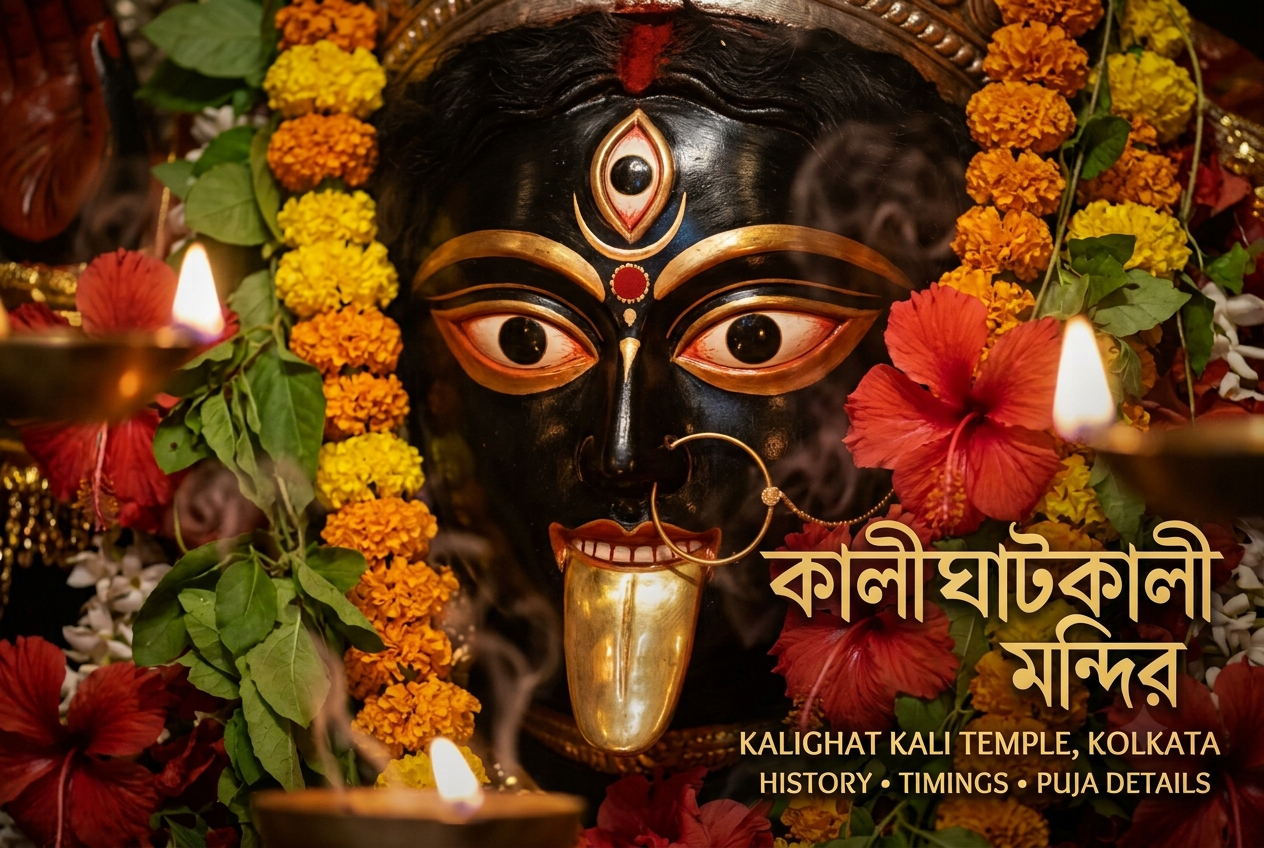
The idol inside the sanctum doesn't look like most Kali images you've probably seen. It's carved from black touchstone, without a conventional carved face, yet devotees see it as intensely alive. What stands out:
- Three large eyes
- A long tongue, plated in gold
- Four hands, two holding a scimitar and the severed head of the demon Shumbha, the other two raised in the Abhaya and Varada mudras, symbols of protection and blessing
Right next to the main sanctum is a shrine to Lord Shiva, worshipped here as Nakuleshwar Bhairav, and the separate Shyam Rai Temple for Radha-Krishna.
There's also a sacred tank inside the complex called Kundupukur. Its water is considered as pure as the Ganga, and devotees, especially couples hoping for children, take a ritual dip here. It's closely tied to the Snan Yatra, a holy bathing festival celebrated at the temple.
Kalighat Temple Timings
| Session | Timing |
|---|---|
| Morning Darshan | 5:00 AM to 2:00 PM |
| Afternoon Break (for Bhog) | 2:00 PM to 5:00 PM, temple closed |
| Evening Darshan | 5:00 PM to 10:30 PM |
Keep in mind that timings can shift slightly during major festivals, so if you're planning an early or late visit around a big occasion, it's worth double checking closer to the date.
Best Days and Times to Visit
- Tuesdays and Saturdays are considered especially auspicious for Kali worship, which also means bigger crowds.
- Ashtami days draw larger numbers of devotees too.
- If you'd rather skip the rush, go early on a regular weekday morning.
Puja and Darshan Details
- Entry: Free for everyone. A paid VIP darshan option exists if you'd rather skip the general line.
- Daily rituals: Aarti, abhishek (ritual bathing of the deity), and bhog offerings happen every day, which is exactly why the temple shuts its doors between 2 PM and 5 PM.
- Special pujas: You can arrange specific pujas, including Annapurna Puja and Kali Puja, directly through the temple authorities.
- Offerings: Flowers, sweets, and puja items are sold at the shops right outside the temple gates.
- Photography: Not allowed inside the temple premises, so leave the camera in your bag once you're at the entrance.
- Dress code: Modest clothing is expected. Men typically wear a dhoti or kurta-pyjama, or a simple shirt and trousers. Women are expected to wear a saree, half-saree, or salwar-kameez with proper coverage. Shorts, sleeveless tops, mini-skirts, and short dresses aren't allowed inside.
Festivals Celebrated at Kalighat Temple
- Kali Puja – The biggest festival of the year, celebrated on Diwali night with elaborate rituals and a massive turnout of devotees.
- Durga Puja – Even though the temple is dedicated to Kali, the nine nights of Navratri and Durga Puja bring huge crowds and festive energy.
- Poila Boishakh – The Bengali New Year, when devotees come seeking blessings for the year ahead.
- Snan Yatra – A ritual bathing festival connected to the temple's sacred tank.
- Rath Yatra and Dondi Utsav – Additional processions held through the year.
Best Time to Visit Kalighat Temple
October to March is the sweet spot for visiting Kolkata, and that includes Kalighat. The weather is pleasant enough for standing in queues and walking through the city, and this window also overlaps with Durga Puja, Kali Puja, and Diwali. If you want to see the temple at its most vibrant, time your trip around one of these festivals.
How to Reach Kalighat Temple
- By Metro: Kalighat Metro Station is the easiest option, just a short walk from the temple.
- By Road: Taxis and autos are readily available from anywhere in central Kolkata.
- By Rail: The temple is about 13 km from Kolkata's main railway station, and easily reachable from there by local transport.